

The Sculpted Ceiling: What Gaudí’s Casa Milà Teaches Us About Bathrooms

Beyond the Porcelain Box: What Gaudí’s Casa Milà Teaches Us About Bathrooms
Walk into almost any newly built or renovated luxury apartment today, and you will likely experience a distinct sense of déjà vu. Whether in Zürich, London, or Milan, contemporary bathrooms have largely converged into a single, predictable template: monolithic large-format porcelain slabs, recessed LED strip lighting tucked beneath floating vanities, and clean, matte black or brushed brass hardware. While these spaces are undeniably sleek and functional, they often lack a true sense of soul, atmosphere, and architectural individuality.
Visiting Antoni Gaudí’s Casa Milà (La Pedrera) in Barcelona this September offered an invigorating antidote to this modern homogeneity. While countless architectural essays celebrate the building’s undulating stone facade or sculpted rooftop chimneys, it was Gaudí’s intimate private quarters—specifically the bathrooms—that resonated most deeply with me.
Rather than treating hygiene spaces as clinical utilitarian boxes, Gaudí conceived them as immersive, sculptural sanctuaries where tactile materials, historical nuances, and natural phenomena gently intersect.
The Ceiling as Atmosphere: Sculpting Water into Plaster
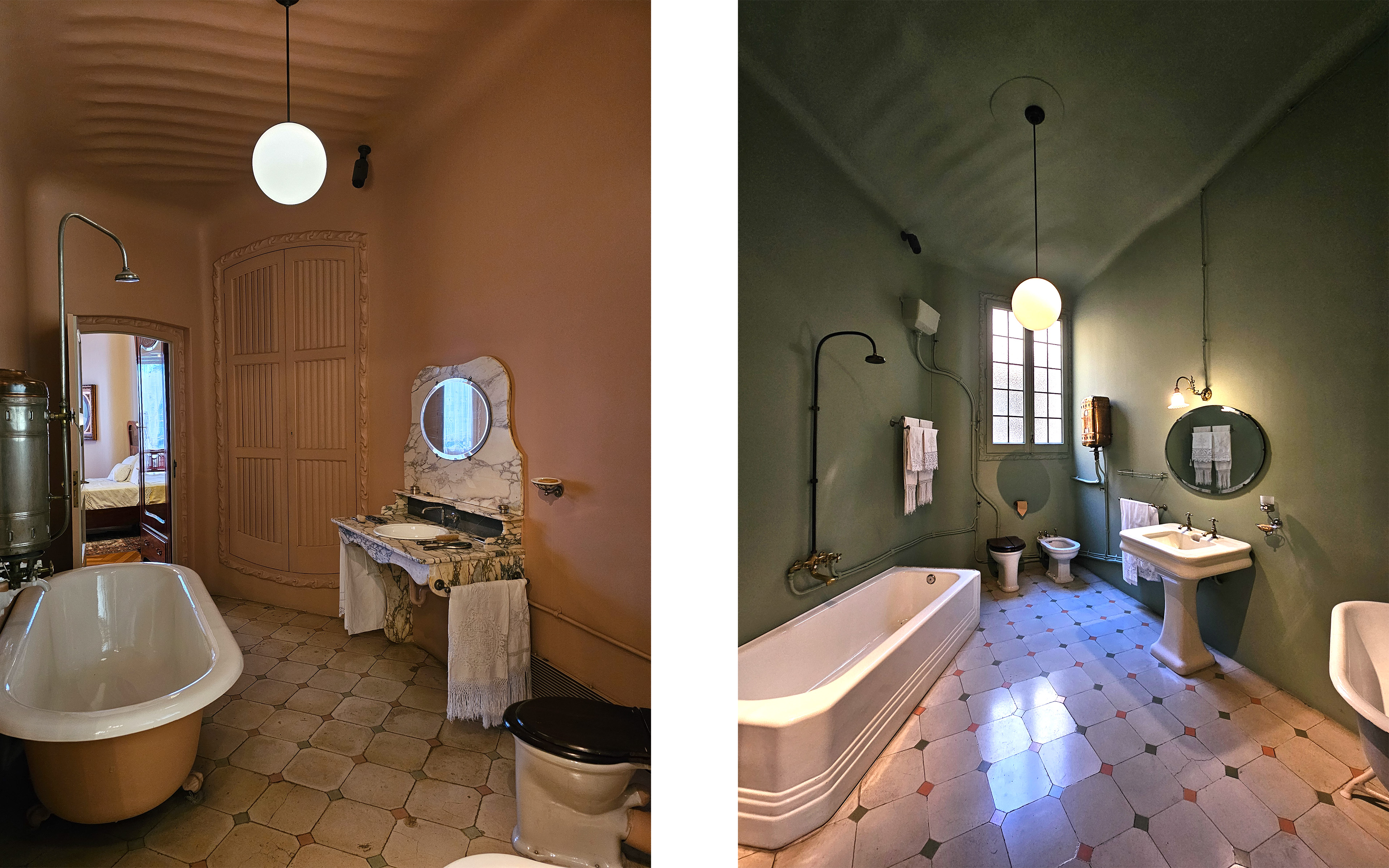
The most captivating detail in these bathrooms reveals itself the moment you look up. Rather than a flat, inert drywall plane, the ceiling is shaped into soft, rhythmic ripples that echo the surface of gently moving water.
Illuminated by a minimalist pendant—a simple frosted globe casting soft, diffused light across the plaster—the undulating ridges create subtle gradients of shadow and warmth. Standing in the space, the optical impression is uncanny: it feels as though the ceiling itself is reflecting the slow, hypnotic movement of water from below. Gaudí brings the elemental nature of water into the very structure of the room, turning what is normally the most neglected surface in modern interior design into the primary carrier of atmosphere.
A Masterclass in Composition and Eclectic Plumbing
What makes these spaces enduringly modern is their compositional freedom. Gaudí did not adhere to a rigid, single-finish rulebook. Instead, he balanced contrasting textures and historical sensibilities with effortless grace:
- Warm Clay and Carved Marble: In the warm terracotta-toned bathroom, a freestanding claw foot tub sits beside a cylindrical vintage water heater, paired with a washbasin sculpted from dramatically veined marble with an integrated baroque-contoured mirror. The hexagonal tiled floor grounds the space with geometric discipline, while the walls wrap the room in tactile warmth.
- Muted Sage and Exposed Infrastructure: In the second bathroom, an earthy sage green envelops the walls and ceiling. Gaudí chose not to conceal every conduit and pipe behind thick drywall chases; instead, exposed metal pipework, an elevated copper cistern, and period tapware become honest, expressive graphic lines that trace the room’s perimeter.
- Light as a Gentle Veil: Both rooms reject aggressive, high-lumen spotlights. Instead, frosted glass window panes and low-hanging spherical pendants provide a soft, ambient glow that allows the eye to rest and shadows to define the contours of the space.
Reimagining Today’s Bathrooms
Modern interiors have gained immense technological efficiency, yet we have often traded away poetic nuance in the pursuit of seamless minimalism. Gaudí’s bathrooms remind us that luxury does not have to mean sterile uniformity.
True luxury in bathroom design lies in considered composition: playing with sculpted relief on ceilings and walls, allowing lighting to flatter rather than interrogate, embracing authentic, patinated metals, and treating plumbing fixtures not as disposable appliances, but as sculptural elements with character and permanence.
Related Articles



toma
Studio

